


Is Your Water Hard, Contaminated, or Both? Here's How to Tell
If you're trying to figure out water softener vs water filter which do i need, here's the short answer:
- Choose a water softener if you see white scale on faucets, spots on dishes, soap that won't lather, or stiff laundry — these are signs of hard water caused by calcium and magnesium minerals.
- Choose a water filter if your water smells like chlorine, tastes off, looks cloudy, or you're concerned about contaminants like lead or PFAS.
- Choose both if you have hard water and water quality concerns — which is common in central Illinois.
Neither system does the other's job. A softener won't remove contaminants, and a filter won't stop scale buildup.
A lot of homeowners treat these two systems as if they're interchangeable. They're not. One targets dissolved minerals that wreck your appliances and plumbing. The other targets contaminants that affect your health and the taste of your water. Picking the wrong one means spending money on a system that won't fix your actual problem.
The good news? Once you know what's in your water, the decision gets a lot simpler.
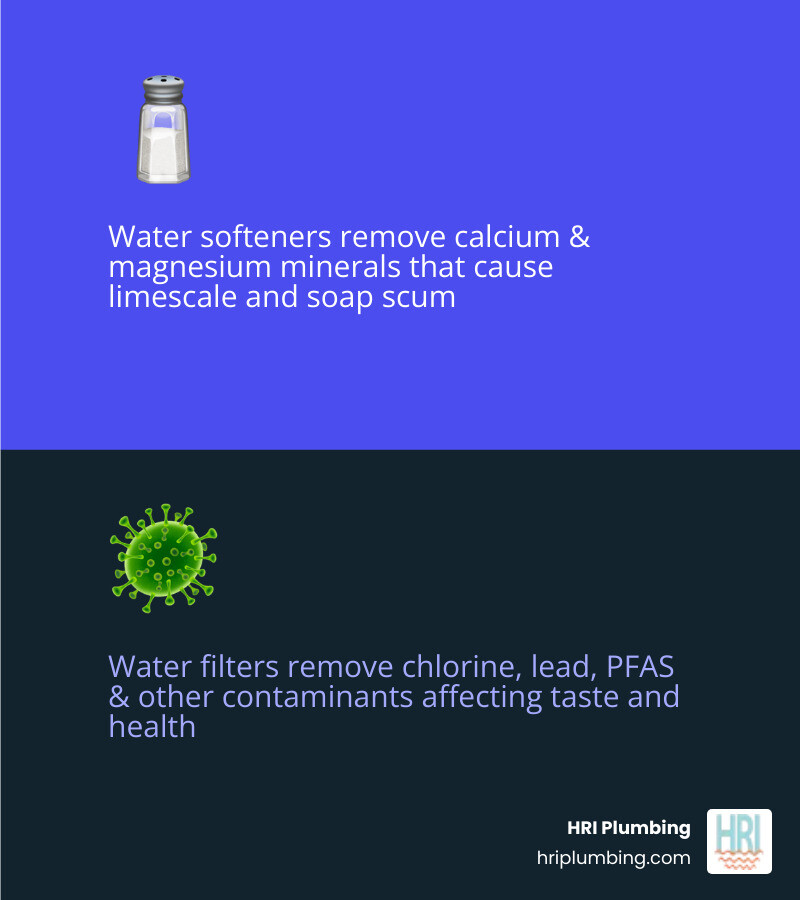
Water Softener vs Water Filter Which Do I Need?
When we talk to our neighbors in Springfield or Jacksonville, the most common frustration we hear is about "the crud." You know the one—that white, chalky crust that grows on your showerhead and makes your coffee maker sound like it’s struggling for its life. That "crud" is limescale, and it is the calling card of hard water.
Understanding Hard Water
Hard water isn't "dirty" in the traditional sense. It’s actually packed with minerals, specifically calcium and magnesium. As water travels through the ground in Illinois, it picks up these minerals from limestone and chalk deposits. We measure this "hardness" in Grains Per Gallon (GPG).
- Soft Water: 0-3.5 GPG
- Moderate: 3.5-7 GPG
- Hard: 7-10 GPG
- Very Hard: 10+ GPG
In many parts of central Illinois, we regularly see numbers well into the "Hard" or "Very Hard" categories. When this water is heated, the minerals crystallize and stick to everything. This causes soap scum in the tub, makes your laundry feel like it was washed in sandpaper, and forces your water heater to work twice as hard. If you're seeing these symptoms, you likely need a softener. If your current system is acting up, we offer Water Softener Repair Springfield IL to get your home back to peak efficiency.
Understanding Water Filtration
On the flip side, you might have water that is perfectly soft but tastes like a swimming pool. Or maybe it has a metallic tang or a cloudy appearance. This is where Water Filtration Springfield IL comes into play. Filters are designed to remove "the bad stuff"—contaminants like chlorine, lead, pesticides, and bacteria.
While a softener uses a chemical process called ion exchange to swap hardness minerals for tiny amounts of sodium, a filter uses physical barriers, carbon adsorption, or oxidation to trap impurities.
| Feature | Water Softener | Water Filter |
|---|---|---|
| Primary Goal | Remove hardness (Calcium/Magnesium) | Remove contaminants (Chlorine, Lead, etc.) |
| Main Benefit | Protects plumbing and appliances | Improves taste, odor, and safety |
| Visible Signs Needed | Scale buildup, spots on dishes | Bad smell, weird taste, cloudiness |
| Process | Ion Exchange | Mechanical or Carbon Filtration |
| Removes Iron? | Only in very small amounts | Yes (with specific iron filters) |
| Maintenance | Adding salt periodically | Replacing filter cartridges |
Deciding Between a Water Softener vs Water Filter Which Do I Need for Well Water?
If you live on the outskirts of Jacksonville or Rushville and rely on a private well, your water challenges are a bit different than someone on city lines. Well water hasn't been treated by a municipal plant, so it often carries "souvenirs" from the earth.
Iron and ManganeseHave you noticed orange or reddish stains in your toilet bowl or on your white t-shirts? That’s iron. While a standard softener can handle a tiny bit of iron, it isn't an iron filter. High levels of iron will "foul" the resin bed of a softener, essentially suffocating it and making it useless. For well owners, we often recommend specialized Water Filtration Jacksonville IL that can handle up to 30 ppm of iron and 15 ppm of manganese.
The "Rotten Egg" SmellNothing ruins a morning shower like the smell of sulfur. This is caused by hydrogen sulfide gas. A water softener will do absolutely nothing for this smell. You need a filtration system—often one that uses oxidation—to neutralize that odor.
Bacteria and SedimentWells can also be susceptible to sand, grit, and even coliform bacteria. A sediment pre-filter is essential to keep your plumbing from clogging, and a UV filter might be necessary to ensure your water is safe to drink. If your well setup is causing grief, our team handles Water Softener Repair Jacksonville IL and filtration installs to keep your well system running smoothly.
Choosing a Water Softener vs Water Filter Which Do I Need for City Water?
If you're in the heart of Springfield, your water has already been treated to meet EPA standards. However, "safe" doesn't always mean "pleasant."
Chlorine and ChloraminesCities use disinfectants like chlorine or chloramines to kill bacteria in the pipes. While effective, it leaves your water tasting and smelling like a public pool. It can also dry out your skin and hair. A whole-house carbon filter is the best way to strip these chemicals out before they reach your tap.
PFAS and "Forever Chemicals"The EPA’s 2024 enforceable limits for PFAS have set the bar at just parts per trillion. These chemicals are incredibly hard to remove and are linked to various health issues. Standard water softeners have zero effect on PFAS. To tackle these, many homeowners look into Reverse Osmosis Systems Springfield IL, which can remove up to 99% of total dissolved solids, including many of these modern contaminants.
Lead ConcernsIf you live in an older home with lead service lines or lead solder in the plumbing, a filter is a non-negotiable health requirement. A softener will not remove lead; you need a certified lead-removal filter or an RO system to protect your family.
Can One System Do Both Jobs?
We often get asked if there’s a "magic bullet" system. The answer is: sort of, but with caveats.
Salt-Free "Softeners" (Conditioners)You may have seen "salt-free water softeners" advertised. It's important to know that these are technically water conditioners. They use a process called Template-Assisted Crystallization (TAC). They don't actually remove the calcium and magnesium; they just change the mineral's structure so it doesn't stick to your pipes.
- Pros: No salt to buy, no wastewater, less maintenance.
- Cons: They don't provide that "slippery" soft-water feel, and they don't help soap lather better.
Multi-Stage SystemsThere are "hybrid" systems that put a carbon filter and a water softener in the same tank. These can be great for small homes with mild water issues. However, for most families in our service areas like Water Filtration Chatham IL, we usually recommend separate units. Why? Because if the filter part wears out, you don't want to have to replace your whole softener, too. Separate tanks allow for better "contact time," meaning the water spends more time being cleaned, leading to better results.
The Benefits of Combining Both Systems
For the "total solution," many of our customers choose to install both a softener and a filtration system. This is the gold standard for home water.
The Ideal Setup OrderIf you're installing both, the order matters! We typically install them in this sequence:
- Sediment Pre-filter: Catches dirt and rust so they don't clog the expensive equipment.
- Whole-House Carbon Filter: Removes chlorine, which can actually damage the resin inside your water softener.
- Water Softener: Removes the hardness minerals.
- Reverse Osmosis (RO): Installed under the kitchen sink for the ultimate drinking water.
By putting the filter before the softener, you extend the life of your softener's resin. By putting the softener before an RO system, you protect the RO's delicate membrane from being "scaled up" by hard minerals.
There are many Key Benefits of Reverse Osmosis, but the biggest one is peace of mind. You get the appliance protection of the softener and the bottled-water quality of the RO system right from your tap.
Final Verdict: How to Choose Your Home Water System
So, water softener vs water filter which do i need? The final decision shouldn't be a guess.
- Check for Symptoms: Do you have spots on your dishes (Softener) or a chlorine smell (Filter)?
- Test Your Water: You can buy DIY strips at the hardware store for a basic idea of hardness, but they aren't always accurate for contaminants.
- Get a Professional Analysis: This is the only way to be 100% sure. We can test for hardness, iron, pH, and more to tell you exactly what’s going on in your pipes.
At HRI Plumbing, we believe in honesty and integrity. We aren't here to sell you a massive system you don't need. If you just have a little bit of chlorine taste, a simple filter might do. If your water is so hard it’s killing your water heater every five years, a softener is an investment that pays for itself in energy savings and appliance longevity.
Whether you need Water Filtration Rushville IL or a complex multi-stage system in Springfield, we’re here to help. We offer 24/7 support and flexible options to fit your home and your budget.
Don't let bad water ruin your plumbing or your morning coffee. Give us a call, and let’s get your water sorted out the right way!


