


What Central Illinois Homeowners Need to Know About Municipal vs Well Water Quality
Municipal vs well water quality in central illinois is one of the most important things to understand as a homeowner in the region — and the differences go well beyond what you can see, smell, or taste.
Here's a quick breakdown of how the two sources compare:
| Factor | Municipal Water | Private Well Water |
|---|---|---|
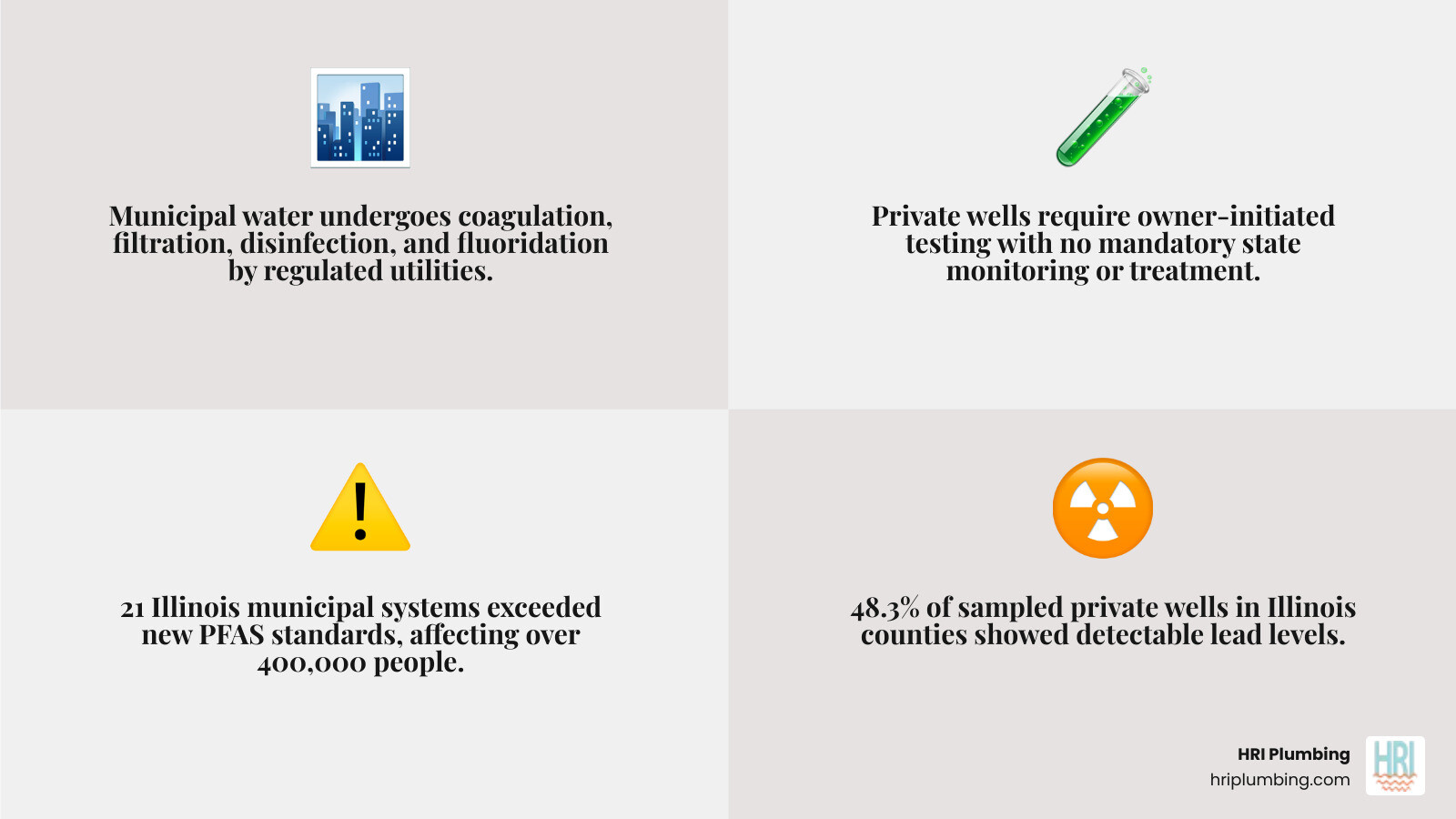
| Treatment | Treated by utility (coagulation, filtration, disinfection, fluoride) | Owner's responsibility — no required treatment |
| Testing | Regular, state-mandated testing with public reports | No required testing; owner must arrange independently |
| Regulation | Governed by EPA and IEPA standards | Not covered by most federal rules (e.g., Lead and Copper Rule) |
| Common contaminants | TTHMs, PFAS, arsenic, nitrates (usually within legal limits) | Lead, nitrates, bacteria, arsenic (no guaranteed monitoring) |
| Lead risk | Monitored via Lead and Copper Rule | 48.3% of sampled wells in IL counties had detectable lead |
| PFAS risk | 21 IL municipal systems exceeded new standards (406,363 people affected) | Private wells may be impacted with no required notification |
| Taste/odor | Can vary seasonally (algal blooms in surface sources like Lake Springfield) | Can vary by geology and local land use |
| Long-term sustainability | Dependent on source management (lake levels, aquifer draw) | Dependent on local aquifer recharge and well condition |
Whether your home is connected to a city system in Springfield or drawing from a private well near Rushville or Jacksonville, the water coming out of your tap has a unique story — and unique risks. Central Illinois sits over important groundwater resources like the Mahomet Aquifer, while cities like Springfield rely on surface water from Lake Springfield. Each source faces its own set of challenges, from agricultural runoff and PFAS contamination to seasonal taste changes and aging plumbing that can leach lead. Understanding those risks is the first step toward protecting your family.
Municipal vs Well Water Quality in Central Illinois: Key Differences
When we talk about municipal vs well water quality in central illinois, we are really talking about two different worlds of oversight. If you live in a city like Springfield or Jacksonville, your water is managed by a municipal utility. These systems are bound by the Safe Drinking Water Act (SDWA) and the Illinois Environmental Protection Agency (IEPA) standards. They are required by law to test for over 150 different chemicals and parameters, often performing dozens of analytical tests every single day.
For example, Springfield’s City Water, Light & Power (CWLP) draws from Lake Springfield. Because this is a surface water source, it is highly susceptible to runoff but undergoes a rigorous multi-stage purification process. On the flip side, many residents in more rural parts of Sangamon, Morgan, or Schuyler counties rely on private domestic wells. These wells often tap into the Mahomet Aquifer or smaller local sand-and-gravel aquifers. While groundwater is naturally filtered by the earth, private wells are not regulated by the EPA. This means the burden of safety falls entirely on us as homeowners.
Treatment Standards and Municipal vs Well Water Quality in Central Illinois
The treatment process is where the biggest gap exists. Municipal systems use a sophisticated "treatment train." In cities like Springfield and Jacksonville, this typically includes:
- Coagulation and Sedimentation: Adding chemicals that make dirt and organic particles clump together so they sink to the bottom.
- Filtration: Running water through layers of sand, gravel, and anthracite to remove the smallest remaining particles.
- Disinfection: Usually using chlorine or chloramines to kill bacteria and viruses.
- Fluoridation: Adding fluoride to help prevent tooth decay, as recommended by the Illinois Department of Public Health.
- Corrosion Control: Adding phosphates to coat the inside of pipes, which prevents lead from leaching into the water.
In contrast, a private well has no "standard" treatment. Most wells simply pump raw groundwater directly into the home. While some homeowners install water softeners to deal with the notorious hardness of Central Illinois water, many are unaware of invisible threats like nitrates or arsenic. For those looking for the highest level of protection, understanding reverse osmosis water treatment is essential, as it can remove contaminants that standard filters leave behind.
Common Contaminants and Municipal vs Well Water Quality in Central Illinois Risks
Even with treatment, municipal supplies aren't immune to issues. A major concern recently has been PFAS, often called "forever chemicals." These man-made substances are found in everything from firefighting foam to non-stick cookware. In Illinois, the IEPA recently notified 47 community water systems of PFAS exceedances. While the Town of Normal detected only trace amounts (2.2 ppt), other systems have had to issue "Right-to-Know" notifications because levels exceeded the new, stricter standards for PFOA and PFOS.
Lead is another significant factor. While municipal utilities are required to follow the Lead and Copper Rule, lead usually enters the water through the "service line" or the home's own plumbing. A study of 151 domestic wells in counties like Peoria and Jackson found that 48.3% had detectable lead in the first draw. This is often due to the corrosivity of the water interacting with older brass fixtures or lead solder.
Other common regional contaminants include:
- Nitrates: Primarily from agricultural runoff; a major concern for infants (Blue Baby Syndrome).
- Arsenic: Naturally occurring in the Mahomet Aquifer. While systems like Morton keep levels below the 10 ppb limit, private wells in the same area may have much higher concentrations.
- TTHMs (Trihalomethanes): These are byproducts of the disinfection process itself. EWG data shows that over 1,600 Illinois utilities had TTHMs above health guidelines.
If you are concerned about these risks, improving water quality through filtration is the best proactive step you can take for your household.
Taste, Odor, and Regional Sustainability
Have you ever noticed your water smells "earthy" or "musty" in the late summer? In Springfield, this is usually due to Geosmin and MIB, non-toxic compounds produced by blue-green algae in Lake Springfield. While these aren't a health risk, they certainly affect your morning coffee! Utilities use powdered activated carbon to scrub these smells, but they can persist during "lake turnover" events.
Long-term sustainability is the bigger "hidden" issue. Central Illinois relies heavily on aquifers. While the Mahomet Aquifer is massive, it isn't infinite. Increased demand for municipal use and irrigation can lead to aquifer depletion. For well owners, this means your pump has to work harder, leading to common problems with well pumps that require repairs if the water table drops or the screen becomes clogged with silt.
Protecting Your Home’s Water Supply
Whether you are on city water or a well, you shouldn't have to guess what's in your glass. For those on municipal systems, your utility is required to provide a Consumer Confidence Report (CCR) every year. These reports list the highest levels of contaminants detected and whether they met EPA standards. You can also look up your local system on the EWG Tap Water Database or the IEPA's Drinking Water Watch.
Testing and Monitoring Requirements
If you are on a private well in the Jacksonville or Rushville areas, you are the "utility manager." There are no state or federal laws requiring you to test your water once the well is drilled. We recommend testing for coliform bacteria and nitrates at least once a year. If you live near industrial sites or heavily farmed fields, testing for PFAS and pesticides is also a smart move.
Recent data from 2023-2025 shows that while most municipal systems in Central Illinois like Springfield and Morton have excellent compliance histories, "Total Trihalomethanes" and "Haloacetic Acids" remain the most frequent exceedances of health-based guidelines (though they often stay within legal limits). For well owners, the risk is more localized; your neighbor’s well might be clean while yours has high arsenic due to the specific pocket of the aquifer you're tapping.
Practical Steps for Cleaner Water
If you’re worried about municipal vs well water quality in central illinois, there are immediate steps you can take:
- Flush Your Pipes: If water has been sitting in your pipes for more than six hours (like when you wake up), run the cold tap for 2 minutes. This significantly reduces lead levels.
- Use Carbon Filters: A simple pitcher or faucet filter can remove many taste and odor issues, as well as some chlorine byproducts.
- Install Reverse Osmosis (RO): This is the gold standard. RO systems can remove lead, arsenic, nitrates, and PFAS. Key benefits of reverse osmosis include peace of mind and bottled-water quality right from your sink.
- Maintain Your Softener: Hard water isn't just a nuisance for your skin; it can cause scale buildup in your pipes that traps contaminants.
Professional Solutions for Central Illinois Residents
At HRI Plumbing, we’ve spent years helping our neighbors in Jacksonville, Springfield, and Rushville navigate these water quality challenges. We know the local geology and the specific quirks of our municipal systems. Whether you need a well pump installation for a new home or a comprehensive water filtration solution to tackle hard water and contaminants, we are here to help.
Our team offers 24/7 support and flexible maintenance plans designed to keep your plumbing and water treatment systems running perfectly. We believe in honesty and integrity—we won't sell you a system you don't need, but we will make sure the water your family drinks is as safe as it can be. If you're ready to take control of your home's water quality, reach out to us today. We’re proud to be your local experts in all things plumbing and water safety.


